写作者模板 - 1.基础
Abstract
包含所有 MyST markdown 的基础语法示例
写作语法部分
本文件示例展示 MyST Markdown(MyST v2)的全部主要语法,
所有示例都使用 MOF(金属有机骨架)主题进行改写,
并全部采用最新推荐的 ::: 块指令语法(fenced directives)。
写作者可直接复制这些模板并改写内容,每个部分后面配有官方格式教程链接,包含更多可扩展的功能。
0. Document (页面前部)
放置在每个markdown文件最开头,以下是本教程的示例。
---
kernelspec:
  name: jupyterbook
  display_name: 'jupyterbook'

title: 写作者模板 - 1.基础
abstract:
  包含所有 _MyST markdown_ 的基础语法示例
---kernelspec: 内容为交互python块的本地搭建jupyter执行环境。
title: 本章的标题,显示在左边栏的内容大纲中。
abstract: 本章的简介 。
1. Typography(排版示例)
1.0 标题与层级
标题采用#来分别层级,会自动生成目录与排版。
# 第 1 章:波函数与概率解释

## 1.1 波函数的物理含义

## 1.2 概率密度与归一化

### 1.2.1 归一化条件
1.1 强调与行内格式
普通文本**加粗文本** 加粗文本*斜体文本* 斜体文本***粗斜体*** 粗斜体
展示`行内代码`部分。 展示行内代码部分。
1.2 引用块(Block Quote)
> MOF-5 由 **Zn₄O** 次级构筑单元(SBU)与 *对苯二甲酸配体(BDC)* 组成。
MOF-5 由 Zn₄O 次级构筑单元(SBU)与 对苯二甲酸配体(BDC) 组成。
1.3 水平线
---
1.4 脚注
如以下的文献所示[1]
如以下的文献所示[^1]

[^1]: This is a review about AI for MOFs.
(最下方会有Footnotes部分,显示脚注内容。)
2. Admonitions(提示、警告等)
Callouts & Admonitions Documents
最新 MyST 推荐使用:
:::{类型}
内容
:::
可用类型:
note
tip
important
warning
admonition
2.1 tip
:::{tip} 什么是配位聚合?
MOF 本质上是由金属离子与多齿有机配体通过配位键形成的晶体骨架。
:::2.2 note
:::{note}
UiO-66 是 Zr 基 MOF 中最稳定、使用最广的结构之一。
:::2.3 warning
:::{warning}
HKUST-1 在潮湿环境下容易发生水分解反应,导致结构崩塌。
:::2.4 通用 admonition
:::{admonition} 自定义块标题
内容……
:::3. Figures(图像)
MyST 推荐使用 fence directive:
:::{figure} path/to/image
:name: image-label-zh
:width: 70%
:align: center
图片说明  (如果不添加:name:标签,则图片说明前不会自动标号Figure N)
:::
传统markdown的语法也可以插入图片:
,但为保持整体格式一致,不推荐在这里使用。
3.1 本地图片
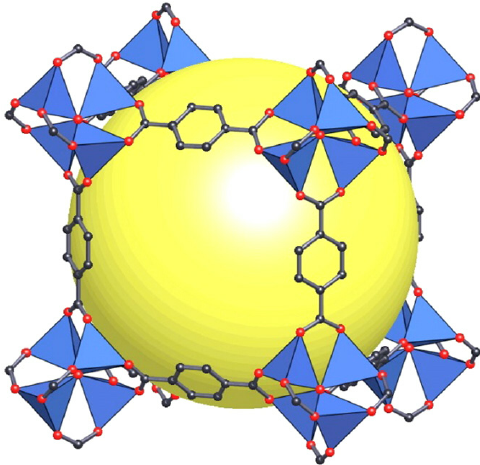
Figure 1:MOF 结构示意图。
3.2 网络图片
4. Math(数学公式)
MyST 支持全部 LaTeX 数学语法。
4.1 行内公式
MOF 孔隙率可写为 。
$\phi = V_\text{void} / V_\text{cell}$
4.2 块级公式
$$
V_\text{cell} = abc\sqrt{
1 + 2\cos\alpha\cos\beta\cos\gamma -
\cos^2\alpha - \cos^2\beta - \cos^2\gamma
}
$$$$
\begin{aligned}
q(P) &= q_{\max} \frac{bP}{1 + bP} \\
\phi &= \frac{V_\text{void}}{V_\text{cell}}
\end{aligned}
$$5. Tables(表格)
5.1 常规 Markdown 表格
| 名称 | 金属中心 | 配体 | 特点 |
| :--- | :--- | :--- | :--- |
| MOF-5 | $\mathrm{Zn}^{2+}$ | BDC | 经典 MOF |
| UiO-66 | $\mathrm{Zr}^{4+}$ | BDC | 极高稳定性 || 名称 | 金属中心 | 配体 | 特点 |
|---|---|---|---|
| MOF-5 | BDC | 经典 MOF | |
| UiO-66 | BDC | 极高稳定性 |
5.2 block表格
:::{table} Table caption
:label: table-zh
:align: center
| head | head |
| --- | --- |
| content | content |
:::| 结构 | 比表面积 (m²/g) |
|---|---|
| MOF-5 | 3800 |
| MIL-101 | 4500 |
6. Cross References(交叉引用)
你可以为任意 block 添加 :name: 并引用。
在Section2里面,引用图片为:

:::{figure} ../images/Figure-1.png
:name: MOF-structure-zh
:width: 70%
:align: center
MOF 结构示意图。
:::
参见 [](#MOF-structure)。
参见 Figure 1。
[第一章的1.2 典型结构示意与晶胞](./ch1-mof-basics-zh#target-struct-zh).
同一目录下可以直接用
./文件名。不同目录下可以用相对路径,比如
../intro/welcome.md。
7. External References(外部引用)
wiki与github等网站可以有特殊直接引用:
<wiki:Metal–organic_framework>
其余外部引用:
[External Reference Documents](https://mystmd.org/guide/external-references)
8. Embedding(嵌入)
[Embedding Documents]
可嵌入本文档或其他文档使用的内容。例如嵌入MOF-book chapter1的Figure1:
:::{embed} ch1-mof-basics.md/#fig-mof-schematic
:::
9. Citations(文献引用)
利用DOI引用:
文献引用:
[MOF paper](doi.org/10.1038/s41578-025-00772-8)
重复引用:
[MOF paper](doi.org/10.1038/s41578-025-00772-8)
如文献 [Yaghi, 2025](https://doi.org/10.1038/s41578-025-00772-8) 所示。
如文献 Yaghi, 2025 所示。
(最下方Reference部分不会有重复引用,如果使用相同doi引用)
10. Proofs and Theorems(定理、证明)
可以添加定理,定义,证明等,利用{prf:关键词}添加,其中关键词可以为theorem,lemma,definition等。
:::{prf:theorem} MOF 稳定性判据
:label: theorem-1-zh
若金属节点配位数足够大,则 MOF 一般更稳定。
:::

:::{prf:proof} 证明
:label: proof-theorem-1-zh
高配位数限制了框架结构的变形自由度,从而提升稳定性。
:::11. Exercises(练习)
:::{exercise}
:label: my-exercise-zh
孔隙率练习
计算边长 3 nm、孔隙率 0.5 的简单晶胞体积。
::::::{solution} my-exercise-zh
$V = 27\text{ nm}^3$。
:::注: exercise要采用label,solution需要写出label。
12. Blocks and Comments(通用块)
12.1 Blocks
Block用于格式分割:
+++ {"cell": "one"}
cell 1
cell 1
12.2 Comments
Comments用于代码中写评论。
This next line won't render, but it is in the HTML and LaTeX!
% Markdown comment line
This next line won’t render, but it is in the HTML and LaTeX!
13. Diagrams(图结构)
流程图等结构支持并且推荐使用 Mermaid架构。
:::{mermaid}
graph TD
    A[金属节点] --> B[配体]
    B --> C[三维网络]
:::
14. Asides(侧边栏)
用于放置旁注,会显示在右边栏:
:::{aside}
ZIF 系列材料在气体分离上表现突出。
:::15. Dropdowns, Cards, Tabs(下拉、卡片、标签)
Dropdowns, Cards, Tabs Documents
15.1 下拉
:::{dropdown} 点击展开 MOF 说明
MOF 是由金属节点与有机配体组成的多孔材料。
:::
点击展开 MOF 说明
MOF 是由金属节点与有机配体组成的多孔材料。
15.2 Tabs
::::{tab-set}

:::{tab-item} 结构
MOF 框架依赖金属节点和有机链接体。
:::

:::{tab-item} 孔隙
孔径决定吸附选择性。
:::

::::MOF 框架依赖金属节点和有机链接体。
孔径决定吸附选择性。
16. Glossaries and Terms(术语表)
:::{glossary}

MOF-zh
: Metal–Organic Framework(金属有机骨架)

SBU-zh
: Secondary Building Unit,次级构筑单元。

:::- MOF-zh
- Metal–Organic Framework(金属有机骨架)
- SBU-zh
- Secondary Building Unit,次级构筑单元。
This is a review about AI for MOFs.
- Zheng, Z., Rampal, N., Inizan, T. J., Borgs, C., Chayes, J. T., & Yaghi, O. M. (2025). Large language models for reticular chemistry. Nature Reviews Materials, 10(5), 369–381. 10.1038/s41578-025-00772-8