Author Template - 1. Basics
Abstract
Contains examples of all basic MyST markdown syntax
Writing Syntax Section
This file demonstrates all the main syntax of MyST Markdown (MyST v2).
All examples are adapted using the MOF (Metal–Organic Framework) theme,
and the latest recommended ::: fenced directive syntax is adopted throughout.
Authors can directly copy these templates and modify the content. Each section includes an official documentation link with more extensible functions.
0. Document (Frontmatter)
Place this at the very beginning of each markdown file. Below is a sample for this tutorial.
---
kernelspec:
  name: jupyterbook
  display_name: 'jupyterbook'

title: Author Template - 1. Basics
abstract:
  Contains examples of all basic _MyST markdown_ syntax
---kernelspec: Specifies the local jupyter execution environment for interactive Python code blocks.
title: The title of the chapter, shown in the table of contents in the left sidebar.
abstract: A brief introduction to the chapter.
1. Typography
1.0
1.1 Emphasis and Inline Formatting
Regular text**Bold Text** Bold Text*Italic Text* Italic Text***Bold Italic*** Bold Italic
Showcase of `inline code`. Example: inline code part.
1.2 Block Quote
> MOF-5 consists of **Zn₄O** secondary building units (SBUs) and *benzene dicarboxylate ligands (BDC)*.
MOF-5 consists of Zn₄O secondary building units (SBUs) and benzene dicarboxylate ligands (BDC).
1.3 Horizontal Rule
---
1.4 Footnotes
As shown in the following reference[1]
As shown in the following reference[^1]

[^1]: This is a review about AI for MOFs.
(The Footnotes section at the bottom will show the footnote content.)
2. Admonitions
Callouts & Admonitions Documents
The latest MyST recommendation is to use:
:::{type}
Content
:::
Available types:
note
tip
important
warning
admonition
2.1 tip
:::{tip} What is coordination polymerization?
MOFs are essentially crystalline frameworks formed by metal ions and multidentate organic ligands through coordination bonds.
:::2.2 note
:::{note}
UiO-66 is one of the most stable and widely used Zr-based MOF structures.
:::2.3 warning
:::{warning}
HKUST-1 is prone to hydrolysis in humid environments, resulting in structural collapse.
:::2.4 General admonition
:::{admonition} Custom Block Title
Content...
:::3. Figures
MyST recommends using the fenced directive:
:::{figure} path/to/image
:name: image-label
:width: 70%
:align: center
Figure Caption  (If the :name: tag is not added, the caption will not be automatically numbered as Figure N)
:::
3.1 Local Images
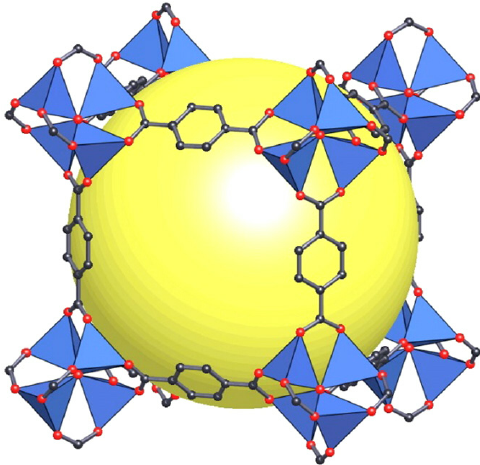
Figure 1:Schematic diagram of MOF structure.
3.2 Web Images
4. Math
MyST supports all LaTeX math syntax.
4.1 Inline Formulas
The porosity of a MOF can be written as .
$\phi = V_\text{void} / V_\text{cell}$
4.2 Block Formulas
$$
V_\text{cell} = abc\sqrt{
1 + 2\cos\alpha\cos\beta\cos\gamma -
\cos^2\alpha - \cos^2\beta - \cos^2\gamma
}
$$$$
\begin{aligned}
q(P) &= q_{\max} \frac{bP}{1 + bP} \\
\phi &= \frac{V_\text{void}}{V_\text{cell}}
\end{aligned}
$$5. Tables
5.1 Standard Markdown Table
| Name | Metal Center | Ligand | Feature |
| :--- | :--- | :--- | :--- |
| MOF-5 | $\mathrm{Zn}^{2+}$ | BDC | Classic MOF |
| UiO-66 | $\mathrm{Zr}^{4+}$ | BDC | Exceptional Stability || Name | Metal Center | Ligand | Feature |
|---|---|---|---|
| MOF-5 | BDC | Classic MOF | |
| UiO-66 | BDC | Exceptional Stability |
5.2 Block Table
:::{table} Table caption
:label: table
:align: center
| head | head |
| --- | --- |
| content | content |
:::| Structure | BET Surface Area (m²/g) |
|---|---|
| MOF-5 | 3800 |
| MIL-101 | 4500 |
6. Cross References
You can add a :name: to any block and reference it.
In Section2, cite the figure as:

:::{figure} ../images/Figure-1.png
:name: MOF-structure
:width: 70%
:align: center
Schematic diagram of MOF structure.
:::
See [](#MOF-structure).
See Figure 1.
[Section 1.2 Typical Structures and Unit Cells in Chapter 1](./ch1-mof-basics#target-struct).
Section 1.2 Typical Structures and Unit Cells in Chapter 1.
7. External References
Websites like wiki and github can be referenced directly:
<wiki:Metal–organic_framework>
Other external references:
[External Reference Documents](https://mystmd.org/guide/external-references)
8. Embedding
[Embedding Documents]
You can embed content from this document or other documents. For example, to embed Figure 1 from Chapter 1 of the MOF-book:
:::{embed} ch1-mof-basics.md/#fig-mof-schematic
:::
Figure 1:A schematic diagram of a MOF structure.
9. Citations
Use DOI to cite:
Citation example:
[MOF paper](doi.org/10.1038/s41578-025-00772-8)
Repeated citation:
[MOF paper](doi.org/10.1038/s41578-025-00772-8)
As shown in [Yaghi, 2025](https://doi.org/10.1038/s41578-025-00772-8).
As shown in Yaghi, 2025.
(No repeated reference will show in the References section at the end if the same DOI is cited multiple times.)
10. Proofs and Theorems
You can add theorems, definitions, proofs, etc. by using {prf:keyword}, where keyword may be theorem, lemma, definition, etc.
:::{prf:theorem} Stability Criterion for MOFs
:label: theorem-1
MOFs are generally more stable if the coordination number of the metal node is sufficiently high.
:::

:::{prf:proof} Proof
:label: proof-theorem-1
A high coordination number restricts the degrees of freedom of the framework structure, thereby increasing its stability.
:::11. Exercises
:::{exercise}
:label: my-exercise
Porosity Exercise
Calculate the unit cell volume of a simple cubic cell with an edge length of 3 nm and a porosity of 0.5.
::::::{solution} my-exercise
$V = 27\text{ nm}^3$.
:::Note: use a label for exercise, and the corresponding label for solution.
12. Blocks and Comments
12.1 Blocks
Blocks are used to segment formatting:
+++ {"cell": "one"}
cell 1
cell 1
12.2 Comments
Comments are used to add annotations within code.
This next line won't render, but it is in the HTML and LaTeX!
% Markdown comment line
This next line won’t render, but it is in the HTML and LaTeX!
13. Diagrams
Flowcharts and similar structures are supported and it is recommended to use Mermaid diagrams.
:::{mermaid}
graph TD
    A[Metal Node] --> B[Ligand]
    B --> C[3D Network]
:::
14. Asides
Used for sidenotes, which will appear in the right sidebar:
:::{aside}
ZIF series materials exhibit outstanding performance in gas separation.
:::15. Dropdowns, Cards, Tabs
Dropdowns, Cards, Tabs Documents
15.1 Dropdown
:::{dropdown} Click to Expand MOF Description
MOFs are porous materials consisting of metal nodes and organic ligands.
:::
Click to Expand MOF Description
MOFs are porous materials consisting of metal nodes and organic ligands.
15.2 Tabs
::::{tab-set}

:::{tab-item} Structure
MOF frameworks rely on metal nodes and organic linkers.
:::

:::{tab-item} Pores
Pore size determines adsorption selectivity.
:::

::::MOF frameworks rely on metal nodes and organic linkers.
Pore size determines adsorption selectivity.
16. Glossaries and Terms
:::{glossary}

MOF
: Metal–Organic Framework

SBU
: Secondary Building Unit

:::- MOF
- Metal–Organic Framework
- SBU
- Secondary Building Unit
This is a review about AI for MOFs.
- Zheng, Z., Rampal, N., Inizan, T. J., Borgs, C., Chayes, J. T., & Yaghi, O. M. (2025). Large language models for reticular chemistry. Nature Reviews Materials, 10(5), 369–381. 10.1038/s41578-025-00772-8